Chasing Turbulence: The Latency Crisis at the Heart of Adaptive Optics
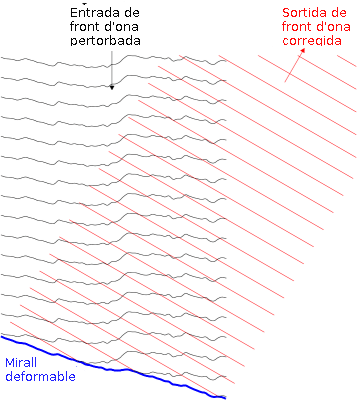
Photo: Original: User:Rnt20, CC BY-SA 3.0, via Wikimedia Commons
For decades, adaptive optics has occupied a privileged position in the optical engineer's toolkit. The premise is elegant: measure the distortion that atmosphere or thermal gradients impose on a wavefront, compute the necessary correction, and apply it through a deformable mirror fast enough that the light arriving at the detector—or the target—behaves as though the distortion never existed. In principle, it is one of the most powerful ideas in applied photonics. In practice, it is one of the most humbling.
The gap between principle and practice is not a matter of insufficient ambition or inadequate funding. It is, at its core, a problem of time—specifically, of the mismatch between how fast atmospheric turbulence evolves and how quickly a real system can sense, compute, and respond to that evolution. That mismatch, measured in milliseconds or fractions thereof, quietly determines whether a system delivers near-diffraction-limited performance or degrades into something little better than an uncorrected aperture.
The Anatomy of a Control Loop Under Pressure
Every adaptive optics system is built around a closed control loop: a wavefront sensor captures phase errors across the beam, a reconstructor algorithm translates those measurements into actuator commands, and a deformable mirror physically reshapes the wavefront. Each step consumes time. The wavefront sensor requires an integration window to accumulate enough photons for a meaningful measurement. The reconstruction algorithm—even a relatively simple least-squares solver—demands computational cycles. The deformable mirror's actuators carry their own mechanical response latency. Summed together, these delays define the system's effective bandwidth.
The atmosphere, unfortunately, does not negotiate. Turbulence characterized by Greenwood frequencies—the metric that captures how rapidly phase distortions evolve—can demand correction bandwidths of several hundred hertz under moderate seeing conditions, and can spike far higher during periods of strong wind shear or thermal instability. When a system's control bandwidth falls short of the Greenwood frequency, correction becomes retrospective rather than anticipatory: the mirror is always chasing a wavefront that has already moved on.
The consequences are not merely academic. In astronomical applications, residual wavefront error translates directly into Strehl ratio loss—a degradation of the peak intensity in the point spread function that compounds across every scientific measurement the telescope makes. In directed-energy and high-power laser applications, the stakes are more operationally immediate. A beam that cannot be held on target due to uncorrected jitter and wavefront error represents a mission-critical failure, not a data quality footnote.
Why Sensing Remains the Binding Constraint
Much of the engineering effort in adaptive optics over the past two decades has focused on computational improvements—faster processors, more efficient reconstruction algorithms, and optimized control architectures. These advances have been real and consequential. Yet they have not resolved the system's deepest vulnerability, which lies upstream of the computation: in the wavefront sensor itself.
The Shack-Hartmann sensor, which remains the workhorse of most deployed systems, divides the aperture into a grid of lenslets and measures local wavefront tilt from the displacement of focal spots on a detector array. Its fundamental limitation is photon noise. To achieve a low-noise measurement, the sensor must integrate for a finite period—but longer integration means the measurement reflects an average over a time interval during which the turbulence has continued to evolve. This creates an irreducible trade-off between signal quality and temporal fidelity that no amount of downstream computation can fully compensate.
Natural guide stars exacerbate the problem. Bright enough reference sources are not always available in the region of sky under observation, forcing systems to rely on laser guide stars—artificial sodium-layer beacons that introduce their own complications, including the well-known cone effect, in which the laser beam samples a conical rather than cylindrical volume of atmosphere and thus misses the outer-scale turbulence that affects the science beam.
The Quiet Acceptance of Degraded Performance
What is rarely discussed openly in the optics community is the degree to which both military and scientific operators have quietly recalibrated their expectations. High-power laser systems designed for atmospheric propagation frequently operate with performance margins built around anticipated wavefront correction shortfalls rather than around the system's theoretical corrected-beam quality. Observatory instrumentation teams schedule observations around periods of favorable seeing rather than relying on adaptive optics to deliver consistent performance across all conditions.
This accommodation is pragmatic, but it also signals that the technology has not yet crossed the threshold from a precision instrument that works well under favorable conditions into a robust system that performs reliably under demanding ones. The distinction matters enormously for the next generation of applications—including space situational awareness platforms, long-range free-space optical communications links, and the extremely large telescope class of astronomical facilities currently under construction in Chile and Hawaii.
Machine Learning and the Predictive Correction Paradigm
The most substantive emerging response to the latency problem does not attempt to make the control loop faster in the conventional sense. Instead, it attempts to make the loop anticipatory—using predictive models trained on turbulence statistics and recent wavefront history to project the state of the atmosphere a few milliseconds into the future and pre-position the deformable mirror accordingly.
Machine learning approaches, particularly recurrent neural network architectures and more recent transformer-based sequence models, have demonstrated meaningful gains in simulation and early laboratory experiments. The intuition is straightforward: atmospheric turbulence is not purely random. It carries spatial and temporal correlations—the frozen-flow hypothesis, which treats turbulence layers as coherent structures advected by wind, provides a reasonable first approximation—that a sufficiently trained model can exploit to anticipate rather than merely react.
Results from groups at several US national laboratories and university observatories suggest that predictive controllers can extend effective correction bandwidth by a factor of two to three relative to conventional integrators under typical turbulence conditions. The challenge is generalization: models trained on one turbulence regime can degrade in performance when conditions shift, and retraining in real time remains computationally demanding.
Novel Sensor Architectures on the Horizon
Parallel to the machine learning thread, a smaller community of researchers is revisiting the wavefront sensing problem itself. Pyramid wavefront sensors, which use a four-sided prism to encode phase information more efficiently than the Shack-Hartmann geometry, have gained traction in the astronomical community and are baselined for several next-generation observatory instruments. Their higher sensitivity per photon allows shorter integration windows for equivalent noise levels—a direct attack on the temporal resolution constraint.
More speculative approaches include Fourier-domain sensing techniques and interferometric architectures that attempt to extract global phase information rather than local tilt, potentially enabling faster reconstruction with fewer measurements. These remain largely in the research phase, but the underlying physics is sound, and the engineering path to practical implementation is becoming clearer.
The Road Ahead
Adaptive optics is not a failed technology. Its record in astronomy alone—enabling ground-based telescopes to achieve resolution that rivals or exceeds space-based platforms across significant portions of the infrared spectrum—represents one of the genuine engineering triumphs of the past thirty years. But the community has lived too long with a performance ceiling that is defined not by optics but by the latency of the loop that surrounds them.
Cracking that ceiling will require simultaneous progress on multiple fronts: faster and more photon-efficient sensors, predictive control algorithms that generalize robustly, and deformable mirror technologies with lower response latency and higher actuator density. None of these advances is individually sufficient. The atmosphere is not a cooperative adversary, and the margin between a system that corrects well and one that corrects well enough to matter operationally remains narrower than most program managers would prefer to acknowledge.
For the optical engineering community, the adaptive optics latency problem is a reminder that the most consequential limitations are often not the ones that appear in the system's specifications—they are the ones embedded in the physics of the measurement itself.