Two Worlds of Stealth: Why Hiding from Thermal Cameras Demands an Entirely Different Physics
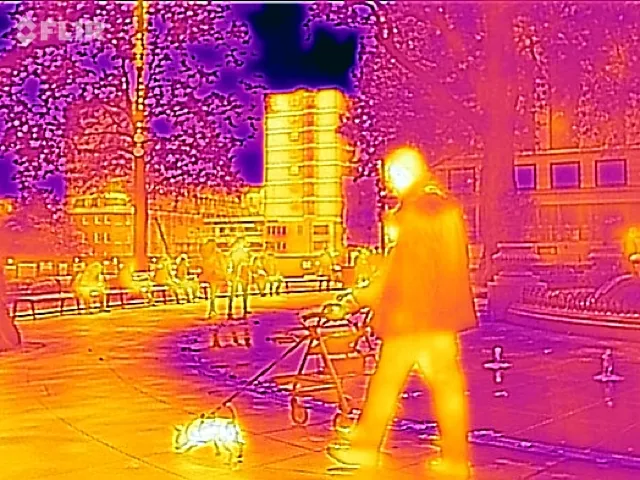
Photo: David Skinner, CC BY 2.0, via Wikimedia Commons
For decades, the popular imagination of optical camouflage has centered on bending, scattering, or absorbing visible light. The metamaterial revolution of the early 2000s gave researchers concrete tools to pursue that vision, and adaptive optical surfaces have since demonstrated remarkable capacity to match a background across the visible spectrum. Yet any defense analyst, field engineer, or security researcher who has watched a thermal camera cut through a state-of-the-art optical concealment system understands the uncomfortable truth: the physics governing infrared detection are so fundamentally different from those governing visible-light manipulation that the two problems may as well belong to separate engineering disciplines.
That gap is not merely a practical inconvenience. It represents one of the more consequential open questions in applied photonics—one with implications stretching from military platforms and surveillance countermeasures to civilian privacy technologies and industrial thermal management.
The Fundamental Divide Between Reflection and Emission
Visible-light camouflage, at its core, is a problem of controlling how photons from an external source—sunlight, artificial illumination—interact with a surface. A system that redirects, absorbs, or pattern-matches incoming radiation can render an object difficult to distinguish from its background. The photons being managed originate elsewhere; the object is a passive participant in their journey.
Thermal imaging operates on an entirely different principle. Every object above absolute zero emits infrared radiation as a direct consequence of its temperature—a phenomenon governed by Planck's law and characterized by the object's emissivity. A thermal camera is not detecting reflected photons; it is detecting photons generated by the object itself. No amount of surface patterning designed to redirect external light will suppress that intrinsic emission. The object is, in a radiometric sense, its own light source.
This distinction collapses the toolkit that optical engineers have spent years refining. A metasurface engineered to achieve near-zero reflectance across the visible spectrum may simultaneously present a high-emissivity surface in the 8–14 micrometer long-wave infrared band—the atmospheric window most exploited by military and commercial thermal sensors. The very materials chosen for their visible-light properties often perform poorly, or even adversely, in the infrared.
Why Emissivity Engineering Is Harder Than It Looks
The instinctive response to the emission problem is to engineer a low-emissivity surface: if an object radiates less infrared energy, a thermal camera will perceive it as cooler, potentially indistinguishable from background clutter. Metallic coatings, for instance, exhibit low emissivity in the infrared and have long been used in thermal insulation applications.
The difficulty is that low emissivity and low reflectance in the visible spectrum are, in most conventional materials, mutually exclusive properties. Metals that suppress infrared emission tend to be highly reflective to visible light—creating a mirror-like signature that is immediately conspicuous to optical observation or even the naked eye. Achieving simultaneous low visible reflectance and low infrared emissivity requires materials whose optical response can be independently tuned across spectral regions separated by more than an order of magnitude in wavelength. That is not a trivial materials science challenge.
Further complicating matters, reducing emissivity does not eliminate the thermal signature—it merely attenuates it. If an object is substantially warmer than its surroundings, even a low-emissivity surface will radiate detectably. True thermal concealment requires either suppressing the temperature differential itself (through active cooling, which introduces its own logistical and power burdens) or engineering a surface whose apparent emissivity matches the background environment dynamically.
The Spectral Crosstalk Problem in Dual-Band Systems
Recent years have seen growing research interest in so-called dual-band or multi-spectral stealth—materials and structures designed to manage their radiative and reflective properties across both the visible and infrared simultaneously. Several research groups, including teams at US national laboratories and university photonics centers, have demonstrated proof-of-concept structures using photonic crystals, selective emitter architectures, and engineered nanocomposites.
The fundamental obstacle these approaches face is spectral crosstalk: modifications to a material's infrared emissive properties frequently perturb its behavior in adjacent spectral bands, including the near-infrared region used by many night-vision systems. A surface optimized for low emissivity in the long-wave infrared may inadvertently become highly reflective in the 1–2 micrometer near-infrared band—a spectral window actively exploited by a wide range of surveillance platforms. Solving one detection modality while inadvertently enabling another is a recurring frustration in the field.
Phase-change materials, particularly vanadium dioxide, have attracted attention as a potential route around this constraint. Vanadium dioxide undergoes a metal-insulator transition near 68 degrees Celsius that dramatically alters its infrared optical properties, and researchers have explored doping strategies to bring that transition temperature closer to ambient conditions. The appeal is a material whose emissivity can be switched, in principle allowing active management of the infrared signature. The practical barriers—transition hysteresis, durability under field conditions, and the challenge of spatially patterning the response—remain substantial.
Adaptive Thermal Surfaces and the Role of Active Control
The most ambitious current research trajectories move away from passive coatings entirely, toward actively controlled thermal surfaces that can modulate their emissive properties in real time. Electrochromic and thermochromic materials offer routes to electrically or thermally triggered emissivity switching. Microelectromechanical structures have been proposed as a means of physically altering surface geometry to tune infrared emission patterns. Liquid-crystal-based approaches, drawing on decades of display technology development, are being investigated for their potential to reconfigure surface optical properties under applied fields.
Each of these directions carries a systems-level cost. Active control requires power, control circuitry, and environmental robustness—requirements that constrain the applications where such technology is feasible. For a stationary installation or a large vehicle platform, those burdens may be acceptable. For a lightweight wearable or a small unmanned system, they represent formidable engineering constraints.
Implications Beyond Defense
While the defense and security dimensions of dual-spectrum stealth attract the most immediate attention, the underlying physics have broader relevance. Thermal management in electronics and photonic systems depends on the same emissivity engineering principles. Building envelope technologies aimed at reducing urban heat island effects are exploring selective emissive coatings. Privacy-preserving wearables—a nascent commercial category—face the same challenge of managing infrared signatures in environments increasingly saturated with thermal imaging capability.
The photonics research community is, in effect, being asked to solve a materials problem that sits at the intersection of radiative heat transfer, structural optics, and dynamic surface engineering. It is a problem that does not yield to any single discipline's standard toolkit.
An Open Problem at the Edge of the Possible
What the thermal invisibility challenge ultimately illustrates is that optical science's most productive decades have largely addressed the manipulation of externally sourced photons. Managing self-generated radiation—tuning what an object broadcasts rather than how it reflects—demands a conceptually different approach, one that the field is only beginning to develop with the rigor the problem deserves.
The thermal camera's advantage over current camouflage technologies is not an accident of engineering immaturity. It reflects a genuine physical asymmetry that will require sustained, interdisciplinary research to meaningfully close. For institutions and companies working at the frontier of photonic materials and adaptive optical systems, few problems offer a more demanding—or more consequential—proving ground.