The Broadband Illusion: Why Optical Coatings Still Fail Across the Full Spectrum
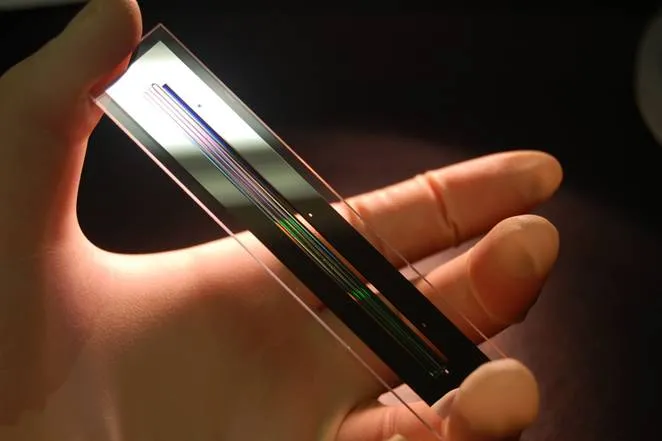
Photo: CILAS, CC BY-SA 3.0, via Wikimedia Commons
The Promise That Thin Films Never Quite Kept
Walk through any photonics laboratory or precision optics manufacturing facility in the United States, and you will encounter optical coatings everywhere — on lenses, beam splitters, windows, and waveguides. These thin-film structures are among the most consequential inventions in modern optics, enabling everything from high-power laser systems to the anti-reflection coatings on everyday eyeglasses. Yet despite decades of refinement, coating engineers routinely encounter a frustrating boundary: the moment a design demands consistent, high-quality performance across a genuinely wide spectral range, the physics begins to push back in ways that no amount of additional layers has fully resolved.
This is not a manufacturing defect. It is not a materials shortage. It is a fundamental tension embedded in the way thin-film optics work — and it is increasingly consequential as emerging applications demand exactly the kind of broadband performance that current coating architectures struggle to deliver.
How Thin-Film Coatings Actually Work
To understand why broadband coatings fail, it helps to understand what they are doing at the physical level. An optical coating consists of one or more layers of dielectric or metallic material deposited on a substrate. Each layer has a specific refractive index and thickness, and the interaction between light reflected from each layer interface produces constructive or destructive interference depending on wavelength. By carefully engineering layer thickness and material selection, designers can suppress reflection at targeted wavelengths, enhance transmission, or introduce controlled phase shifts.
The difficulty is that interference is inherently wavelength-dependent. A layer thickness optimized to cancel reflection at 1,550 nanometers — a wavelength critical to fiber-optic communications — will behave very differently at 900 nanometers or 2,000 nanometers. Adding more layers can extend the effective bandwidth, but each additional layer introduces new opportunities for phase mismatch, thermal expansion stress, and scattering at layer boundaries. The stack grows more complex, and the margin for error shrinks accordingly.
The Specific Wavelength Combinations That Break Everything
The challenge becomes most acute when applications require simultaneous, high-quality performance across wavelength ranges that do not naturally cooperate. Broadband LiDAR systems, for example, are increasingly being designed to operate across portions of both the near-infrared and short-wave infrared bands — sometimes spanning from roughly 850 nanometers to beyond 1,600 nanometers. This range crosses the absorption edges of common coating materials, meaning that a material well-suited to one portion of the spectrum may become absorptive or mechanically unstable at another.
Integrated photonic platforms present a related but distinct problem. Silicon photonics chips often require on-chip or chip-edge coatings that must handle multiple wavelength channels simultaneously, each with its own phase and polarization requirements. A coating that performs admirably on a single-channel basis can introduce differential phase shifts across channels — effectively scrambling the phase relationships that coherent optical systems depend on.
Medical imaging systems designed around broadband illumination face similar constraints. Fluorescence microscopy platforms that excite and collect across multiple spectral bands require coatings on dichroic mirrors and bandpass filters that transition sharply between reflection and transmission at precise wavelengths. Achieving those sharp transitions without introducing ripple — small oscillations in transmission or reflection across the passband — is extraordinarily difficult when the target spectrum is wide.
The Physics-Based Trade-Offs Manufacturers Cannot Escape
At the heart of the broadband coating problem lies a set of trade-offs that cannot be engineered away, only managed. The first is the relationship between layer count and scattering loss. Every additional layer deposited on a substrate introduces a new interface, and every interface is a potential site for scattering caused by surface roughness, contaminants, or crystallographic defects in the film. As layer counts climb into the dozens or even hundreds — as they must for very wide bandwidth designs — cumulative scattering loss can become significant enough to degrade system performance even when individual layers are of high quality.
The second trade-off involves the mismatch between the thermal expansion coefficients of adjacent layers. Coatings are typically deposited at elevated temperatures and must perform across a range of operating temperatures. When adjacent layers expand and contract at different rates, stress accumulates at interfaces, which can cause delamination, cracking, or gradual shifts in layer thickness — all of which alter the spectral performance of the coating over time. This problem is particularly severe for coatings that span large wavelength ranges, because the layer thicknesses required are larger in absolute terms, meaning that small percentage errors in thickness control translate into larger absolute deviations.
The third trade-off is perhaps the most fundamental: the availability of suitable coating materials. Broadband designs require materials with high refractive index contrast — to achieve strong interference effects with fewer layers — and low absorption across the entire target spectrum. No material currently in widespread commercial use satisfies both requirements across the full near-infrared to mid-infrared range. Hafnium oxide, tantalum pentoxide, and silicon dioxide are workhorses of the industry, but each has spectral regions where absorption rises, refractive index falls, or deposition characteristics become unpredictable.
Where the Field Is Heading
Research groups at institutions including MIT, Stanford, and several national laboratories are pursuing approaches that may eventually ease these constraints. Nanolaminate coatings — structures in which extremely thin alternating layers of two materials are deposited to create an effective medium with tunable optical properties — offer the possibility of engineering refractive index profiles that do not exist in any single natural material. Computational design tools, including inverse design algorithms that treat the coating stack as an optimization problem rather than a hand-tuned structure, are enabling exploration of design spaces too large for traditional approaches.
Atomic layer deposition, which allows individual atomic monolayers to be placed with sub-nanometer precision, is beginning to make inroads in applications where conventional physical vapor deposition cannot achieve the thickness uniformity required. And a small number of companies are experimenting with rugate coatings — structures in which the refractive index varies continuously rather than in discrete steps — which can suppress the reflection ripple that plagues conventional broadband designs.
None of these approaches has yet produced a commercial coating that definitively solves the broadband problem for the wavelength combinations most critical to LiDAR and integrated photonics. Each carries its own manufacturing complexity, cost premium, or residual limitation.
A Problem Worth Taking Seriously
The persistence of the broadband coating challenge is easy to overlook, because coatings are invisible in the finished product and their failures are often subtle — a few tenths of a decibel of excess loss here, a slight phase ripple there. But as optical systems are asked to operate over wider spectral ranges and with tighter performance tolerances, the accumulated cost of these imperfections grows. For the engineers designing the next generation of autonomous vehicle sensors, medical imaging platforms, and photonic integrated circuits, the coating stack is no longer a solved problem that can be assumed away. It is a constraint that shapes what can be built — and what cannot.
Until the physics of thin-film interference yields to a more complete solution, the broadband optical coating will remain one of the field's most consequential unsolved problems: invisible, ubiquitous, and quietly limiting the ambitions of optical science at every wavelength.